Since their meeting in Cadaqués in 1929, Gala played a pivotal role in Salvador Dalí’s career. From early on, she became his right-hand woman and arranged everything so that he could devote himself exclusively to creating: she organised his schedule, acted as his agent, managed all manner of exhibition, publishing and artistic projects and, at times, she also collaborated in their realisation, as in the case of the Dream of Venus pavilion for the 1939 New York World’s Fair or the 1942 autobiography, The Secret Life of Salvador Dalí, which she proofread and typeset.
Without love, without Gala, I would not be Dalí. This is a truth that I will never cease to proclaim and live by. She is my blood, my oxygen.
Salvador Dalí and André Parinaud, Comment on devient Dalí, Robert Laffont, Paris, 1973
There is a role – that of muse and model – which has forever shaped the image we all have of Gala and which, at the same time, has also limited our perception of what she truly was. Contrary to how it might appear, Gala was not a submissive muse, subject to the whims of the great artist. She was the privileged witness to Dalí’s creation and also the critical eye that assessed its quality before time determined its transcendence. Moreover, she was a cultivated and gifted person, capable of stimulating artistic creation. In Dalí’s words, Gala was the bee that discovered and brought him all the essences that became the honey of his thought. And who tirelessly wove the Penelope’s web of his disorder. “Because Gala has always known better than I,” writes Dalí, “what I need in order to work.” In fact, it is largely thanks to her, the collecting bee that gathered and organised the nectars and fruits of Dalí’s thought, that the Fundació Gala-Salvador Dalí today treasures in its reserves the most extensive collection of Dalinian documentation and works.
For all these reasons, Gala was a fundamental part of what is known as the Gala–Salvador Dalí partnership. A kind of creative and vital alliance that included both of them and also encompassed the spaces they imagined, built and inhabited. It is no coincidence that, as early as the 1930s, the artist signed many of his finest works with a double signature; on the contrary, this was Dalí’s way of showing Gala’s essential contribution to his success: “By signing my paintings Gala-Dalí, I have done nothing other than give a name to an existential truth, since without my twin Gala I would not exist.”1
Although history has often downplayed Gala’s involvement in the Dalí project, the truth is that many people close to the couple also recognised the decisive role she played in relation to the artist. The Hungarian photographer Gyula Halász, better known as Brassaï, referred to Gala’s influence in his book Conversations avec Picasso: “As for Gala, lover, inspiration, teacher, muse and businesswoman all at once, she took the reins of the ‘Dalí phenomenon’; his great success is, in large part, her doing.”2 In his autobiography, Julien Levy, Dalí’s leading gallerist in America during the 1930s, recounted the impression Gala made on him during a meeting in Paris: “It seemed to me that Gala was doing more to guide than to diffuse this maniac missile, and I believed her when she said she wanted no more than the ‘chance’ for Dalí.”3 The writer Josep Pla also spoke of her as a “decisive influence” in the fourth series of his Homenots (Great Men): “Everything suggests that this lady helped him a great deal and in every respect. Even if the artist had not expressed his gratitude countless times, the fact would be absolutely obvious.”4
1 Salvador Dalí and André Parinaud, Comment on devient Dalí, Robert Laffont, Paris, 1973.
2 Translated from: Brassaï, Conversations avec Picasso, Paris, Editions Gallimard, 1964, p. 42.
3 Julien Levy, Memoir of an art gallery, New York, G.P. Putnam’s Sons, 1977, p. 74.
4 Josep Pla, Obra completa, Barcelona, Ediciones Destino, 1982, XXIX, p. 191-192.

Double-exposure of Gala and Salvador Dalí at Portlligat
c. 1930
Salvador Dalí and Gala working on the “Dream of Venus”
Schaal, Eric
1939

GALA DALI. Illustration for “The Secret Life of Salvador Dalí”
Dalí i Domènech, Salvador
[c. 1939-41]
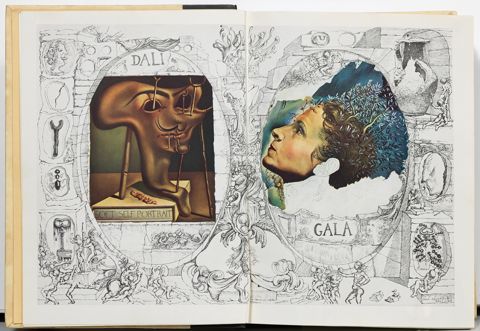
The Secret Life of Salvador Dalí
Dalí, Salvador
1942
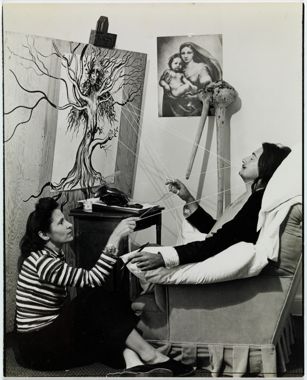
Gala and Salvador Dalí during the period of writing “50 Secrets Magic Craftsmanship” in Del Monte Lodge
1947

Untitled. After “A Political allegory” by Leonardo da Vinci
Dalí i Domènech, Salvador
c. 1950s
Gala “tête a chateau”
c. 1970
…we live like all artists; we work for what is most important: the possibility for a talent to express itself.
Draft letter from Gala to her father, c. 1945