Confident of the image she wants to project, Gala finds in fashion a legitimate and powerful form of expression and self-discovery, which allows her to add nuances to the legend she aspires to be. From a chosen supporting role, Gala excels in the art of camouflage: she disguises herself as a muse and model, but she is also a businesswoman, collaborator and performer when the occasion demands.
A journey through the documentary archives of the Centre for Dalinian Studies and Gala’s wardrobe allows us to discover the femme dandy of avant-garde Paris, dressed in the Chanel style that so well represented the liberated and practical woman she was. We also find a more transgressive Gala who, in the 1930s, opted for Elsa Schiaparelli’s designs, following a strategy devised to publicise Salvador Dalí’s collaboration with the Italian couturière. During her American period, she was particularly drawn to the designs of Arthur Falkenstein – the favourite American label of the artistic circle – although she occasionally turned to Howard Greer when she wanted to look like a Hollywood star. Later, she moved from androgynous comfort to the public corseting of her figure. With the creations of Christian Dior, she would dress in flowers to project an enchanting femininity.
During the 1950s and 1960s, Gala amassed pieces by the most prominent designers of the time, such as Hubert de Givenchy, Jean Dessès, Oleg Cassini, Emilio Pucci and Pierre Cardin, as well as exuberant and dazzling pieces of jewellery by Mimi di Niscemi and Kenneth Jay Lane. Later, in the 1970s, she opted for creations with an oriental and bohemian air, by Marc Bohan for Dior, Michel Goma for Lanvin or Elizabeth Arden, but also for more daring pieces, such as the blazer by Maurice Renoma, which served as a creative stimulus for Salvador Dalí to create one of the last works to give Gala a central place in the composition, Battle in the Clouds (c. 1979).
Ultimately, Gala’s fashion archive, preserved in the collections of the Fundació Gala-Salvador Dalí, is a mirror of the culture and society of her time. Her legacy speaks to us of identity, but also of craftsmanship, mastery, heritage and creativity. Haute couture attire by the most prestigious designers of the 20th century, such as Elsa Schiaparelli, Christian Dior, Jean Dessès or Hubert de Givenchy, coexist with prêt-à-porter creations by Oleg Cassini, Pierre Cardin, Maurice Renoma or Loewe, as well as various unlabelled pieces that remind us that Gala’s image went beyond brands: it was the reflection of a unique and free personality that, above all, always remained true to itself.

Evening coat
Elsa Schiaparelli
Alta costura tardor-hivern 1935

Jacket and skirt ensemble
Arthur Falkenstein
c. 1945

Musée du Louvre ensemble
Christian Dior
Alta costura, primavera-estiu 1949, línia “Trompe-l’œil”
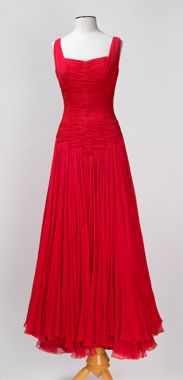
Evening dress
Jean Dessès
c. 1956
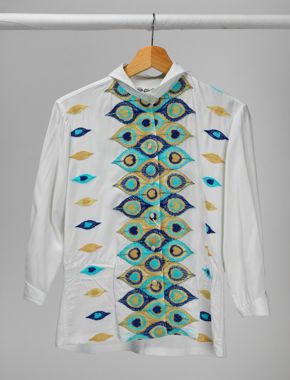
Blouse
Oleg Cassini
c. 1958

Blouse and skirt ensemble
Marc Bohan
c. 1970

Blazer
Maurice Renoma
1970s