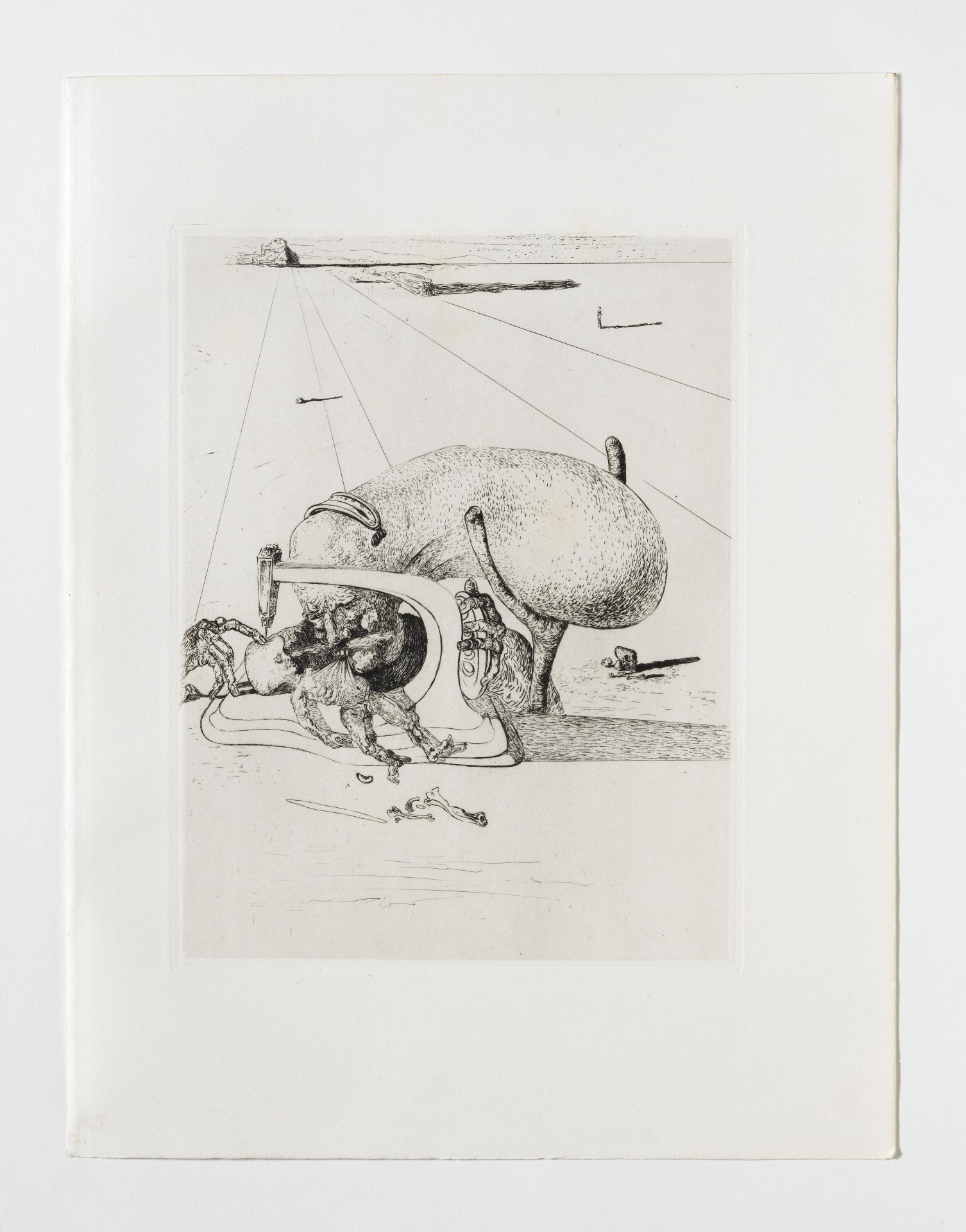
The documented graphic work of Salvador Dalí for the years from 1924 to 1940 falls into two distinct periods, both chronologically and stylistically. The first, corresponding to the 1920s, is primarily associated with the artist’s family and friends. The second period, the 1930s, coincides with Dalí’s move to Paris following his break with his family due to his relationship with Gala Éluard and his entry into the Surrealist movement, of which he almost immediately became a prominent member.
Dalí’s graphic work from this first period includes works inspired by his surroundings in Figueres and his period of study in Madrid (1922-1926). Most of these prints were created using intaglio techniques, with the exception of the 1925 book-plate, drawn in pen and ink and reproduced at a local print shop, which constitutes an early example of the incorporation of photomechanical processes into the artist’s work. Taken together, these pieces bear witness to Dalí’s commitment to this discipline. Of note among them is Cap de noia (Head of a girl), an etching from 1924 that includes a discarded maculature or cognate, Retrat del pare (Portrait of the artist’s father), on the reverse of the sheet. Another significant work, Estudi de nu femení en repòs (Study of a female nude at rest), reproduces a celluloid matrix etched in drypoint and printed with graphite powder. Both prints coincide with Dalí’s student years in Madrid at the Special School of Painting, Sculpture and Engraving of the Real Academia de Bellas Artes de San Fernando.
This was a turbulent period, during which Dalí was suspended for his entire second year, from late October 1923. Even so, the young artist continued to work intensely, returning to Figueres and resuming his studies with Don Juan Núñez, a renowned master of engraving who had been his art teacher in senior school.
Indeed, the graphic work of this early period reflects the influence of a number of sources, such as Jean-Auguste-Dominique Ingres (1780-1867); the Catalan Futurist poet Joan Salvat-Papasseit (1894-1924); and Picasso (1881-1973), who, having created Cubism in tandem with Georges Braque (1882-1963), was then associated with the rappel à l’ordre movement in Paris.[1] A small group of Dalí’s prints, intimate in style and etched in drypoint on celluloid, reflect his deep friendship with Federico García Lorca (1898-1936); meanwhile, the book-plate of 1925 is evidence of his relationship with his first patron, Josep Puig Pujades (1883-1949), a Catalan writer and prominent politician in the province of Girona.
Regarding the second stage of Dalí’s graphic work, corresponding to his Surrealist period from 1930 on, it is worth noting that this includes highly significant works created using intaglio techniques, most of which are linked to limited-edition books produced in renowned print workshops and intended for a specialist market. For example, the first frontispiece that Dalí created for the Second Manifesto of Surrealism (1930) proceeds from an ink drawing reproduced in phototype with colour applications using the pochoir or stencil technique, a specialized artisanal process with a long tradition in France. Dating from the same year are three other books—L’Immaculée conception by André Breton and Paul Éluard, René Char’s Artine, and La Femme visible by Dalí himself—featuring photogravure reproductions from original ink drawings with drypoint retouching by the artist.
In 1933, Dalí created the thirty full-page illustrations for Les Chants de Maldoror (1934), a seminal work in the form of six prose cantos by the young poet Isidore Ducasse, better known by his pseudonym, the Comte de Lautréamont (1846–1870). The prints were reproduced using photogravure from drawings and drypoint engravings on celluloid by the artist.
Between 1935 and 1938, Dalí’s graphic work reflects the influence of North American culture, the result of his several trips to the USA. This influence is especially evident in the print Cranes mous et harpe cranienne (1935), whose composition evokes the ceaseless movement of the modern urban world. In contrast, in Cours Naturel (1938), the love poems by Paul Éluard, Dalí captures ‘the heart-rending cries coming from Republican Spain’ during the Spanish Civil War.[2] In 1939, with the outbreak of World War II, the artist went into exile in the United States, where he remained until 1948.
[1] See Fanés, Félix et. al., Salvador Dalí: The Early Years, Hayward Gallery Publishing, London, 1994, p. 91.
[2] André Breton, feuille volante broadside Cours Naturel.