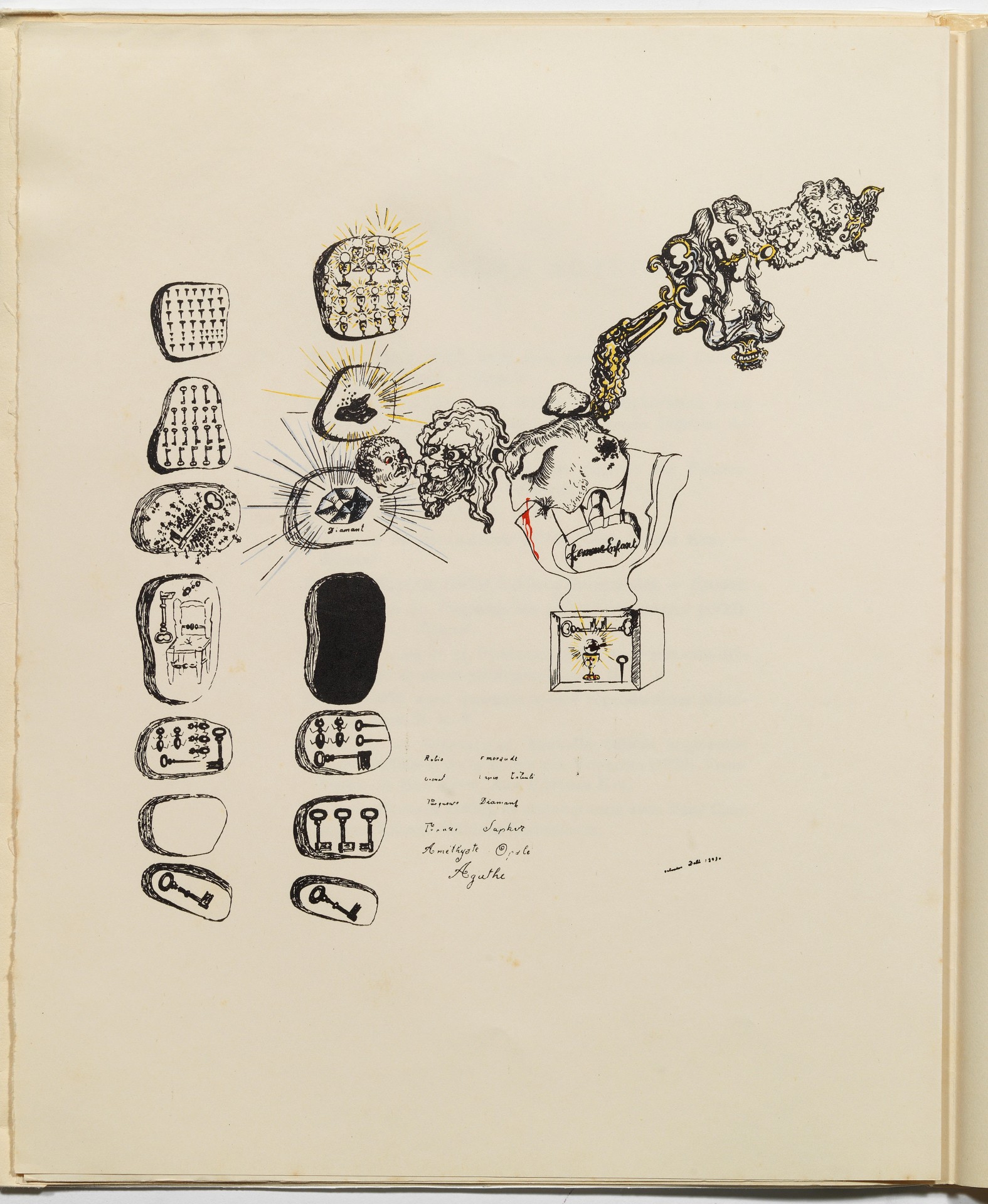
This digital edition of the Catalogue Raisonné of Salvador Dalí’s Graphic Works offers a complete and chronological overview of the artist’s graphic work.
The section About the Catalogue Raisonné has six main subsections, comprising a chronological overview, the characteristics of the original graphic works, a glossary of terms, the methodology used to create the catalogue raisonné, this user manual, and the team behind it. Additionally, a link is included that provides a detailed overview of the context for and classification of the artist’s graphic works.
Users can access the works through the search engine, by opting for either a simple search or an advanced search with a series of fields to complete. The catalogue can also be explored by way of the chronological index of works or by collection. In the latter case, the works are classified according to the owner, the institution or the collection to which they currently belong.
The information in the entry for each work, whether individual or part of a series, is structured in several sections and fields, corresponding to the parameters established in the Artistic criteria of the Fundació Gala-Salvador Dalí regarding graphic work: classification.
Further information on those prints that are part of a set or series is also provided in one or two introductory pages on the set or series.
GENERAL INTRODUCTION TO THE GRAPHIC WORKS
The index of works displays the main data serving to identify each item, allowing it to be classified within Salvador Dalí’s original graphic work by means of its catalogue raisonné number and the title of the print, the series, and the year of production.
The display of these works varies according to their type: (1) an individual print; (2) an individual print included in a published book (frontispiece), a print that is part of a set, whether in a book, folder, or other format; and (3) a set comprising several volumes.
For prints in type (1), the user directly accesses the entry for the work, which includes explanatory text and other specific fields, together with an image of the work, which can be viewed in high resolution.
For prints in type (2), there is an initial presentation page for the work, indicating the title and year, an explanatory text, and other details; images in a carousel; and a view of the prints in the set. For some prints, a timeline at the top indicates the existence of other editions of the work. The user has the option of selecting each print individually, with its detailed profile, together with an image, which can be explored in high resolution.
For prints in type (3), there is an initial presentation page, indicating the title and year, an explanatory text, and other details, as well as images in a carousel. At the top, the user can view and browse the different volumes of the collection. When one of these volumes is selected, a presentation page is displayed featuring a carousel of images with the associated prints. The user has the option of selecting each print individually, with its detailed profile, together with a high-resolution image.
The content of each field is then broken down into three sections: (1) Initial Presentation of the Work, (2) Detailed Presentation of the Print, and (3) Additional Information about the Print. These sections contain the information corresponding to each of the prints listed in the Catalogue Raisonné of Salvador Dalí’s Graphic Works.
1. INITIAL PRESENTATION OF THE WORK
Cat. No. OG
Each work in the Catalogue Raisonné of Salvador Dalí’s Graphic Works has its own unique permanently associated number, presented with the initials OG.
Title
The original title of a graphic work is the title recognised as designating it by the artist. The documentation associated with the relevant editions has been reviewed and corroborated, together with a survey of period documentation, exhibition catalogues, Dalí’s own writings (both manuscripts and publications), and existing catalogues raisonnés.
First, the original title of the work is given (in italics and bold), followed by its translation into the language selected by the user (in regular and bold). Next, if applicable, other known titles of the work from Dalí’s lifetime are noted in the selected language in regular type. These are usually the titles assigned by the artist, although they may also be known from other documentary sources, always dating from Dalí’s lifetime.
In the case of prints that are also book frontispieces, these are indicated by their generic terminology and are presented in the selected language in regular type and bold.
Where the original title assigned by Dalí is not known, but other titles published during the artist’s lifetime have been identified, these will be shown in regular type and bold, translated into the selected language.
When neither the original title nor any other title identified during Dalí’s lifetime is known, the work is usually given as ‘Untitled’, in regular type and bold. There may be cases where a descriptive title is also included, preceded by the ascription ‘Untitled.’
Where typographical or spelling errors have been detected in a title, these have been corrected and the original title, as it first appeared in publication, is recorded under the section heading ‘Observations’.
The titles of many of the works studied include a Catalan place name, and this has been standardised in accordance with the updated Nomenclàtor oficial de toponímia de Catalunya, the official gazetteer of Catalonia.
Series Title
The series title refers to one or more items that form part of a single set. In many instances, such a set is a published book with illustrations by the artist. In other instances, the set is a group of items compiled in a portfolio or other format, brought together under a shared concept. The series title is given in italics.
Image
The reproductions of the works are in colour or monochrome, in accordance with the work itself. In some instances, more than one image is shown to further supplement the information presented.
Index of works and volumes – a small, low-resolution image
Carousel– a medium-size, low-resolution image
Print image – a large, high-resolution image
Copyright
The caption below the image provides information on reproduction rights and copyright of the graphic work. For further information, please contact the Fundació Gala-Salvador Dalí’s Copyright Department: maznar@fundaciodali.org.
2. DETAILED PRESENTATION OF THE PRINT
This section provides detailed information about the work: author, date, technical description, signature, etc.
Type of original graphic work
This provides a classification of the graphic work according to the Artistic criteria of the Fundació Gala-Salvador Dalí regarding graphic work. Double-clicking on this point links to the Original Graphic Work section, giving a concise explanation of the distinguishing characteristics of each type of original work by Salvador Dalí.
Presentation text
Given the complexity and variety of the graphic work, a brief description presents information relating to the creation, iconography, and context of the item under consideration, with supplementary details to facilitate a fuller appreciation of the artist’s graphic work.
Specifics of the set
An image and basic information are provided for the additional or secondary images of this item, such as vignettes, suites, proofs, plate decomposition, or other graphic elements of the copy.
Other editions
This includes a link providing information on other editions.
Related multimedia content
This includes a link to a variety of multimedia content related to this item.
Title of the written work
The title of the book or other published work.
Author of the written work
The full name of the author of the book or other published work.
Series
The series is the set of graphic works created by the artist, in which the prints are conceptually and thematically related and published together.
Author of the print
The author of the print – Salvador Dalí i Domènech – or Salvador Dalí i Domènech and another artist or artists if the authorship is shared.
Description of the work
The formal characteristics of the item.
Date of production
The dating of the work corresponds to the date of its creation, which has been determined in several ways.
For published books, series, and sets of graphic works with a print run justification, credit is given to the date of production indicated on the item itself.
For works for which justification of the print run is not available, credit is given to whether the work is dated by Dalí himself, directly on the item, and/or in any related document (a contract or other document associated with the creative process). Exhibition catalogues from the work’s first exhibition are also considered, as well as other catalogues of graphic works, etc.
In some instances, a specific date cannot be determined due to a lack of precise information, with an indication instead of a date preceded by the lower-case c. (circa) or a probable range of two or more years. The button on the right gives access to the index of works and the display of all works within the same chronology.
Publisher
This refers in all instances to the publisher of the first edition of the work. Subsequent editions, if any, will be noted on the timeline.
Printer
This refers in all instances to the printer of the first edition of the work. When there is more than one printer, their names will be separated by a slash.
Engraver
This refers to the engraver of the print.
Technique and support
This indicates the technique used to create the graphic work and its support.
Dimensions
The dimensions of the work are detailed in centimetres and correspond to height, width, and depth, in this order. The measurements are taken directly from the work. Where this was not possible, information provided by the relevant institution is given.
Signature
The signature is described, together with its location on the work, and whether it is a handwritten or a plate signature, a monogram, or a stamped impression. Also noted where relevant is the absence of a signature or if the work was signed by the artist at a later date.
Owner
This section identifies the current owner of the work.
Location
This section indicates the name of the institution, museum, or collection in which the work is currently held. If the owner has chosen to remain anonymous, the location is listed as a private collection. There is a link from this section to the list of collections.
Provenance
This section notes any previous locations of the item when these are reliably known.
3. ADDITIONAL INFORMATION ABOUT THE PRINT
Inscriptions
This refers to text located on the print or elsewhere in the book containing the print. This inscription may be handwritten—a dedication or other annotation in pencil or pen, etc.—or printed text.
Collection marks
Noted here are any stamps or other indications associating the work with a specific collection, a private individual, a publisher, etc.
Date notes
In some instances, the date on the plate differs from the publication date, because the illustration reproduced predates the printing of the edition.
Copy number
This field notes the copy number.
Watermark
This section details the watermark(s) on the paper, if any.
Embossing
This section provides a literal transcription of any embossing.
Observations
This section includes any other information, comments, or references to the graphic work of special relevance for its study or understanding.
Edition
This refers to the specific unitary set of works, the number of which is usually decided in advance by the artist and their publisher.
Bibliography
This section lists the most important publications—monographs, exhibition catalogues, press clippings, etc. —containing a reproduction of the work in question, noting the page on which it appears.
Exhibitions
A list, in chronological order, of the major exhibitions in which the work has been shown.
Related works
This section notes other works with a some significant relation to the print in question, such as drawings, paintings, other graphic works, etc.