Description
- Number of catalogue raisonné OG:
- OG 014
- Owner:
- Spanish State
- Repository:
- Gala-Salvador Dalí Foundation
- Collection:
- Gala-Salvador Dalí Foundation, Figueres
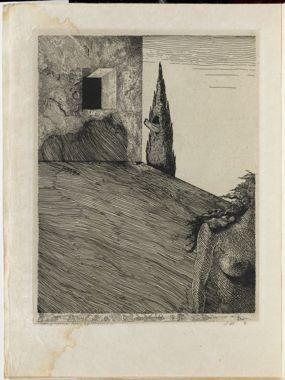
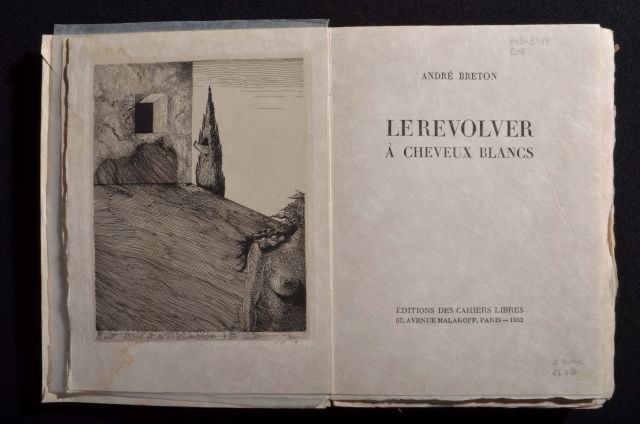
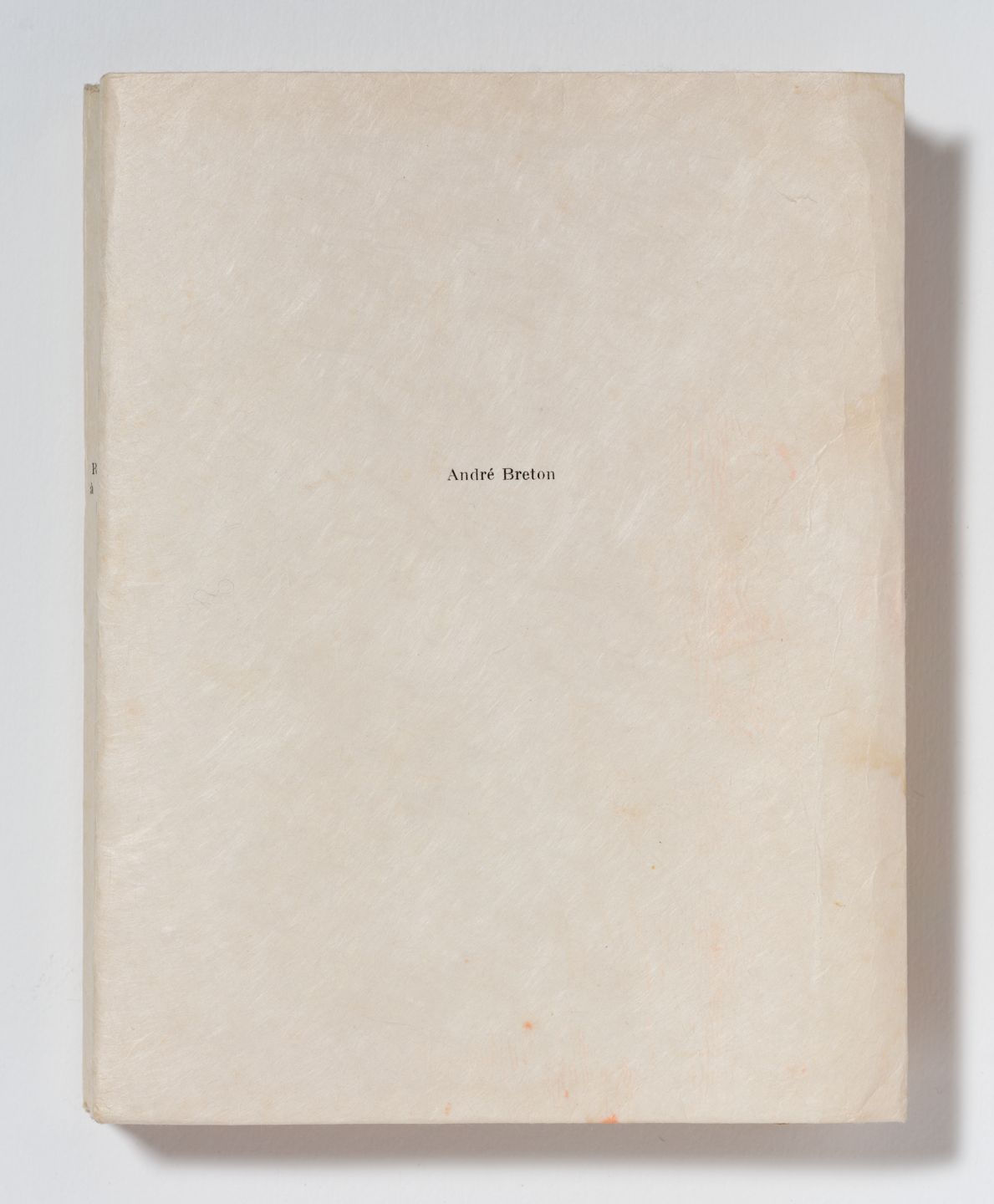
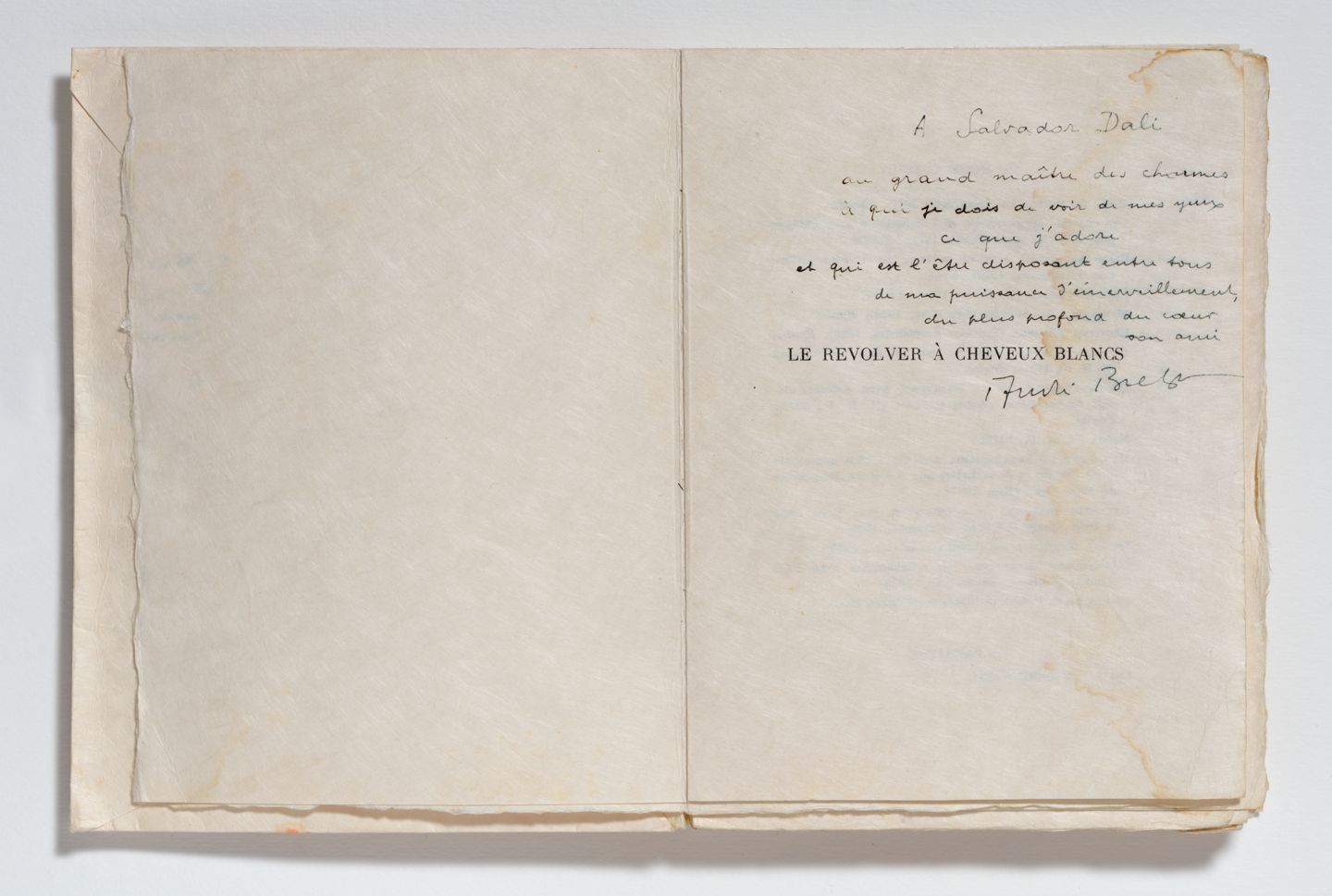
André Breton dedicated his collection of poems, Le Revolver à cheveux blancs, to Paul Éluard. The first ten copies were illustrated with a frontispiece by Salvador Dalí, reproduced in rotogravure and etching on Japanese paper. According to the colophon, the book was printed on 25 June 1932, at Imprimerie Union, for the Paris imprint Éditions des Cahiers Libres. This copy has markings along the bottom margin of the plate, the inscription ‘imprimé par Lacourière’ (printed by Lacourière), and the artist’s initials on the bevel. It is the copy belonging to the illustrator, Salvador Dalí, and has a dedication from André Breton on the half-title page: ‘To Salvador Dalí / to the great master of enchantments / whom I must see with my own eyes / whom I adore / and who is the being that possesses all / of my power of wonder / from the depths of my heart / your friend / André Breton’. (1) Dalí’s print, imbued with mystery and eroticism, seems to capture the poetic essence of the book, whose lyrical development is conceived as a ‘natural itinerary of the loving embrace’. (2) Le Revolver à cheveux blancs is part of a set of three books of surrealist poetry published simultaneously by Éditions des Cahiers Libres under the motto ‘Le sujet de ce libre est un être mobile’ (The subject of this book is a mobile being). (3) Each of the other two volumes in the set, Paul Éluard’s La Vie immédiate and Tristan Tzara’s Où boivent les loups, has a frontispiece by Max Ernst printed by Roger Lacourière. __________ (1) ‘A Salvador Dali / au grand maître des charmes / à qui je dois de voir de mes yeux / ce que j'adore / et qui est l'être disposant entre tous / de ma puissance d'émerveillements / du plus profond du coeur / son ami / André Breton.’ (2) Bonnet, M. (ed.), André Breton Oeuvres complètes II, Éditions Gallimard, 1992, p. 1336. Bonnet quotes Christine Martineau-Geniez, for whom the poem is ‘calquée sur l’itinéraire natural de l’étreinte amoureuse’ [modelled on the natural course of an amorous embrace’]. (3) Op.cit., p. 1312-1313. Bonnet notes that the three books were published under the same rubric: ‘Le sujet de ce libre est un être mobile’.
- Original title:
- The gun with white hair
- Publication title:
- Le Revolver à cheveux blancs
- Series:
- LE REVOLVER À CHEVEUX BLANCS
- Distinctive features:
- Illustrator's copy
- Physical description:
- Book with print (frontispiece)
- Production type:
- Individual limited edition original work - Original limited edition
- Print Author :
- Salvador Dalí i Domènech
- Author of the publication :
- André Breton
- Editor:
- Éditions des Cahiers Libres
- Production date:
- 1932
- Copy number:
- Illustrator's copy
- Production location:
- Paris, France
- Observations on production:
- Notes on the production 1- 10 (10): Pearlescent Japan paper with Dalí etching. 11 - 1010 (1000): Alpha - without illustration The justification for the edition's run does not include the twelve illustrated books - some with the frontispiece on a separate sheet - that were printed on blue Montgolfier paper and numbered separately (I – XII) by André Breton, who gave them to his friends, including Gala Éluard, René Crevel and René Char. In reference to the state of the plate, there are four groups (i, i.i, ii, iii). Likewise, there is evidence of another separate group that differs from these by the larger size of the paper (iv.) i. The pieces numbered 1 – 10 on Japan paper with remarques, inscription and handwritten signature by the artist. i.i - (Variant of the first) Copy not included in the justification of the print run. These are the copies named by the authors and the publisher – we are aware of the publisher's copy and of the illustrator's copy (the FGSD copy). With remarques, inscription and signature of the artist, with the exception of the copy of the artist himself. ii. On blue paper, twelve copies in Roman numerals, numbered by the author André Breton. Some contain the frontispiece on a separate sheet. iii. Separate proofs of which some are presented without remarques and with inscription. iv. Separate proofs on paper of a larger format, some with remarques and without inscription.
- Object history:
- Artist's collection
Related historical documentation
- Salvador Dalí (il.), Dalí et les poètes, Filipacchi, Paris, 1971, 23
- Salvador Dalí: rétrospective, 1920-1980, Centre Georges Pompidou, Musée National d'Art moderne, Paris, 1979, 135
- Salvador Dalí: retrospektive, 1920-1980, Prestel, München, 1980, 135
- Dalí y los libros, Mediterrània, [Barcelona], 1985, 89
- Dalí and his books, Generalitat de Catalunya, [Barcelona], 1987, 37
- Dalí y los libros, Mediterrània, The Kobe Shimbum, [Barcelona], [Tokyo], 1987, 76
- Salvador Dalí, 1904-1989, Gerd Hatje, Stuttgart, 1989, 413
- André Breton, la beauté convulsive, Centre Georges Pompidou, Paris, 1991, 205
- André Breton y el surrealismo, Ministerio de Cultura, [Madrid], 1991, 184
- Dalí a knihy, Generalitat de Catalunya. Departament de Cultura., Mediterrània, Barcelona, 1992, 37
- Mason, Rainer Michael, Dalí verdadero / grabado falso : la obra impresa 1930-1934, IVAM. Centre Julio González, València, 1992, 15
- Salvador Dalí, catalogue raisonné of etchings and mixed-media prints 1924-1980, Prestel, Munich, 1994, 127
- Cento libri surrealisti, Centro Di, Firenze, 1996, 98
- Dalí. Arquitectura, Fundació Gala-Salvador Dalí, Fundació Caixa de Catalunya, [Barcelona], [Figueres], 1996, 40
- Albert Field, The Official catalog of the graphic works of Salvador Dalí, The Salvador Dalí Archives, New York, 1996, 15
- Surrealist prints, Harry N. Abrams, New York, 1997, 48
- Surrealism: two private eyes, the Nesuhi Ertegun and Daniel Filipacchi collections, Guggenheim Museum Publications, New York, 1999, 17
- André Breton : 42, rue Fontaine : tableaux modernes, scuptures, estampes, tableaux anciens, Calmels Cohen, Paris, 2003, 140
- Dalí : afinidades electivas, Generalitat de Catalunya. Departament de Cultura., Barcelona, 2004, 462
- Dalí : afinitats electives, Generalitat de Catalunya. Departament de Cultura., Barcelona, 2004, 462
- Dalí, Bompiani, [Milà], 2004, 207
- Dalí una vida de llibre = Dalí a life in books, Destino [etc.], Barcelona, 2004, 125
- Persistence and memory : new critical perspectives on Dalí centennial, Bompiani, [Milà], 2004, 82
- Dalí, Rizzoli, New York, 2005, 207
- Montse Aguer i Teixidor, Dallibres, Distribucions d'Art Surrealista, [Figueres], 2005, 13
- Mark A. Roglán, DeMaria, Shelley, Claire Barry, Peter Van de Moortel, Dali : poetics of the small, 1929-1936, Meadows Museum, Dallas, 2018, 112
-

Instrument massoquista
c. 1934
-

Dona amb pa català
c. 1932
-

El senyal de l'angoixa
c. 1932-36
-

Encontre de la il·lusió i del moment detingut
1932
-

Objet à fonctionnement symbolique
1931
The copyright on Salvador Dalí's works, included those that are reproduced in this Web page, is held by the Spanish State and has been granted in exclusivity to the Fundació Gala-Salvador Dalí.
Pursuant to intellectual property laws in force, the total or partial reproduction, distribution, transformation, public communication, interactively making available to the public, as well as any other exploitation, by any means, of the works included in this Web page is prohibited.
Any exploitation of Salvador Dalí's works is subject to the prior application and clearance of the relevant licence issued by VEGAP (tel. 91 532 66 32 and 93 201 03 31 ; www.vegap.es). Copyright infringement will be prosecuted according to Laws.