Description
- Number of catalogue raisonné OG:
- OG 013
- Owner:
- Gala-Salvador Dalí Foundation
- Repository:
- Gala-Salvador Dalí Foundation
- Collection:
- Gala-Salvador Dalí Foundation, Figueres
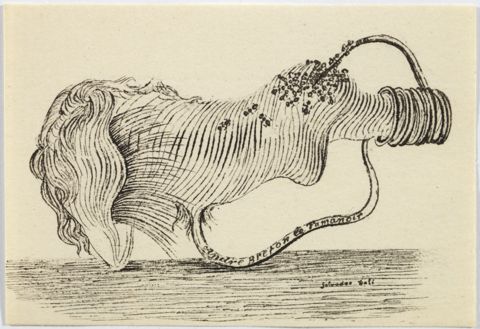
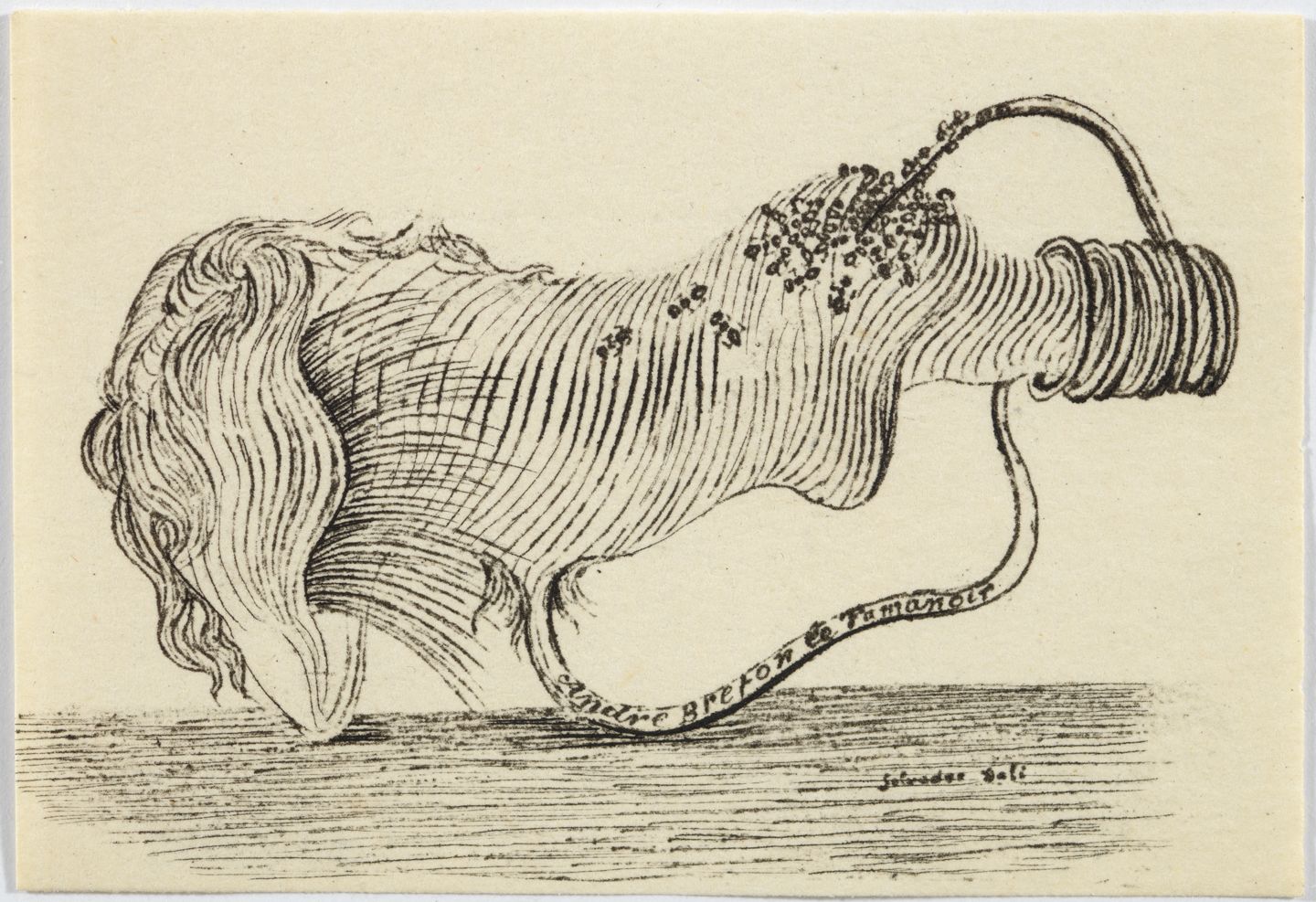
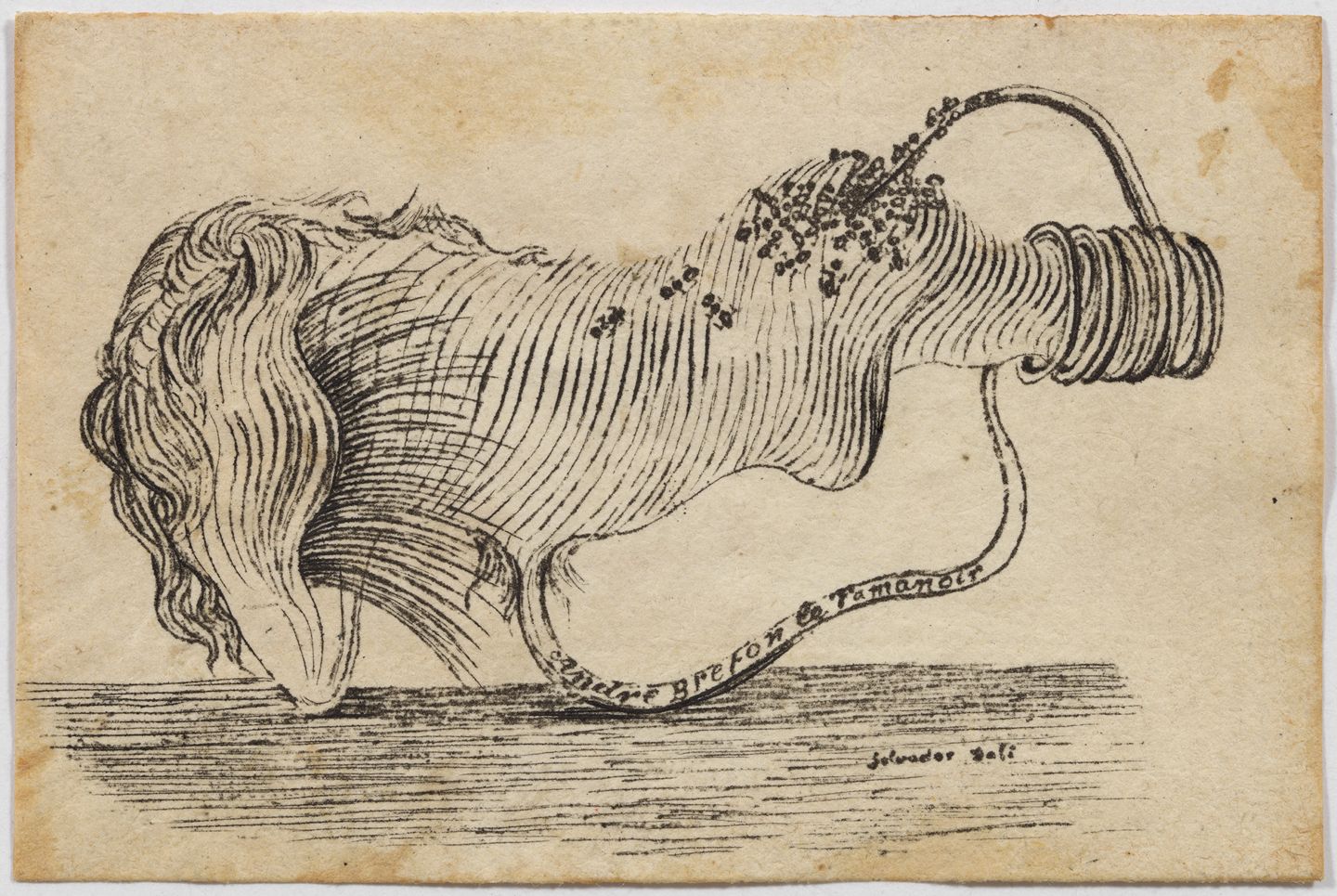
The bookplate for the French poet André Breton was probably commissioned during the autumn of 1930. Dalí created an ink drawing depicting Breton as an anteater whose head evokes the figure of the Great Masturbator, surrounded by ants, insects that, it seems, both men detested. Documents from the period show that, a year earlier, both Dalí and Breton had used the image of the anteater in their respective works. On October 24, 1929, the Barcelona newspaper Mirador published an article about Un Chien Andalou, recently premiered in Paris and about to be shown in Barcelona, in which Dalí stated that the film was a ‘simple anotació, constatació de fets’ (simple annotation, confirmation of facts). To illustrate this idea clearly, he offered the anteater as an example: ‘…it can grow larger than a horse, possesses enormous ferocity, has exceptional muscular strength, is a terrible animal. The anteater eats only ants, using a tongue half a metre long, as thin as a wire.’ (1) A month later, André Breton compared Dalí to an anteater. In the preface to the catalogue of the artist’s first exhibition in Paris, which opened on 25 November 1929, at the Galerie Goemans – a show that included the oil painting The Great Masturbator (Cat. P 235) – Breton wrote: ‘Life presents itself to man with seductions comparable to those that the anteater’s tongue must offer to ants.’ (2) Another instance of the close collaboration between the two can be seen in the letter Breton sent to Dalí on 10 January 1931, shortly before taking the drawing to the printer, in which he asks for one last correction: ‘…if there is still time […] change the banner on the bookplate from ‘André le fourmilier’ to ‘André le tamanoir’.’ (3) This is how it appears in Dalí’s final bookplate, reproduced using rotogravure at a Parisian printing house. Breton’s poem, ‘Après le Grand Tamanoir’, dated in Lyons-la-Forêt on May 20, 1931, was published in Le Surréalisme au service de la révolution no. 3 in December of the same year. (4) Later, Breton included it in Le Revolver à cheveux blancs, a volume of poems published in June 1932 and illustrated with a frontispiece by Dalí. __________ (1) Biblioteca Virtual de Prensa Histórica > Lista de Números (mcu.es) (2) ‘André Breton : 42, rue Fontaine : tableaux modernes, sculptures, estampes, tableaux anciens’, Calmels Cohen, Paris, 2003, p. 141. ‘La vie est donnée à l’homme avec des séductions comparables à celles que doit offrir aux fourmis la langue du fourmilier.’ (FGSD-D-047343) (3) Memoria de los sueños: Salvador Dalí, 1904-1989, MUVIM 2001, p. 95. (4) Bonnet, M. (ed.), André Breton Oeuvres complètes II, Paris, Éditions Gallimard, 1992, p. 1333. Marguerite Bonnet suggests that: ‘The image of the anteater […] represents the waiting, at once neutral and attentive, before beings and things, which for Breton is the essence of the poetic attitude.’
- Attributed title:
- André Breton, Le Tamanoir
- Known Title 1 :
- The giant anteater
- Series:
- ANDRÉ BRETON, LE TAMANOIR
- Distinctive features:
- Exlibris of André Breton
- Physical description:
- Exlibris
- Production type:
- Singular original work
- Print Author :
- Salvador Dalí i Domènech
- Production date:
- 1931
- Production location:
- Paris, France
- Object history:
- Acquisition 2013
Related historical documentation
- Salvador Dalí ... a panorama of his art, The Salvador Dalí Museum, Cleveland, 1974, 149
- Salvador Dalí: rétrospective, 1920-1980, Centre Georges Pompidou, Musée National d'Art moderne, Paris, 1979, 125
- Salvador Dalí: retrospektive, 1920-1980, Prestel, München, 1980, 125
- Robert Descharnes, Dalí : la obra y el hombre, Tusquets / Edita, Lausanne, Barcelona, 1984, 94-95
- André Breton, la beauté convulsive, Centre Georges Pompidou, Paris, 1991, 484
- Mason, Rainer Michael, Dalí verdadero / grabado falso : la obra impresa 1930-1934, IVAM. Centre Julio González, València, 1992, 6
- Salvador Dalí, catalogue raisonné of etchings and mixed-media prints 1924-1980, Prestel, Munich, 1994, 126
- Robert Descharnes, Gilles Néret, Salvador Dalí, 1904 -1989, Benedikt Taschen, Köln, 1994, 158
- Memòria dels somnis: Salvador Dalí, 1904-1989, Govern d'Andorra. Ministeri de Turisme i Cultura, [Andorra de la Vella], 1999, 57
- Fèlix Fanés, Salvador Dalí, la construcción de la imagen : 1925-1930, Electa, [Madrid], 1999, 158
- Dalí il·lustrador : Salvador Dalí, 1904-1989, Govern d'Andorra. Ministeri de Turisme i Cultura, Andorra, 2001, 69
- Memoria de los sueños : Salvador Dalí, 1904-1989, MUVIM (Museu Valencià de la Il·lustració i la Modernitat), València, 2001, 95
- André Breton : 42, rue Fontaine : tableaux modernes, scuptures, estampes, tableaux anciens, Calmels Cohen, Paris, 2003, 141
- Atmosfera Dalí, Ajuntament de Cadaqués, Societat l'Amistat, Cadaqués, 2004, 31
- Dalí : afinidades electivas, Generalitat de Catalunya. Departament de Cultura., Barcelona, 2004, 140
- Dalí : afinitats electives, Generalitat de Catalunya. Departament de Cultura., Barcelona, 2004, 140
- Dalí, Bompiani, [Milà], 2004, 427
- Dalí una vida de llibre = Dalí a life in books, Destino [etc.], Barcelona, 2004, 119
- El País de Dalí, Consorci del Museu de l'Empordà, Figueres, 2004, 57
- Fèlix Fanés, La Pintura y sus sombras : cuatro estudios sobre Salvador Dalí, Museo de Teruel, Teruel, 2004, 82
- Dalí, Rizzoli, New York, 2005, 427
- Salvador Dalí : La gare de Perpignan - Pop, Op, Yes-yes, Pompier, Hatje Cantz, Ostfildern, 2006, 190


The copyright on Salvador Dalí's works, included those that are reproduced in this Web page, is held by the Spanish State and has been granted in exclusivity to the Fundació Gala-Salvador Dalí.
Pursuant to intellectual property laws in force, the total or partial reproduction, distribution, transformation, public communication, interactively making available to the public, as well as any other exploitation, by any means, of the works included in this Web page is prohibited.
Any exploitation of Salvador Dalí's works is subject to the prior application and clearance of the relevant licence issued by VEGAP (tel. 91 532 66 32 and 93 201 03 31 ; www.vegap.es). Copyright infringement will be prosecuted according to Laws.